
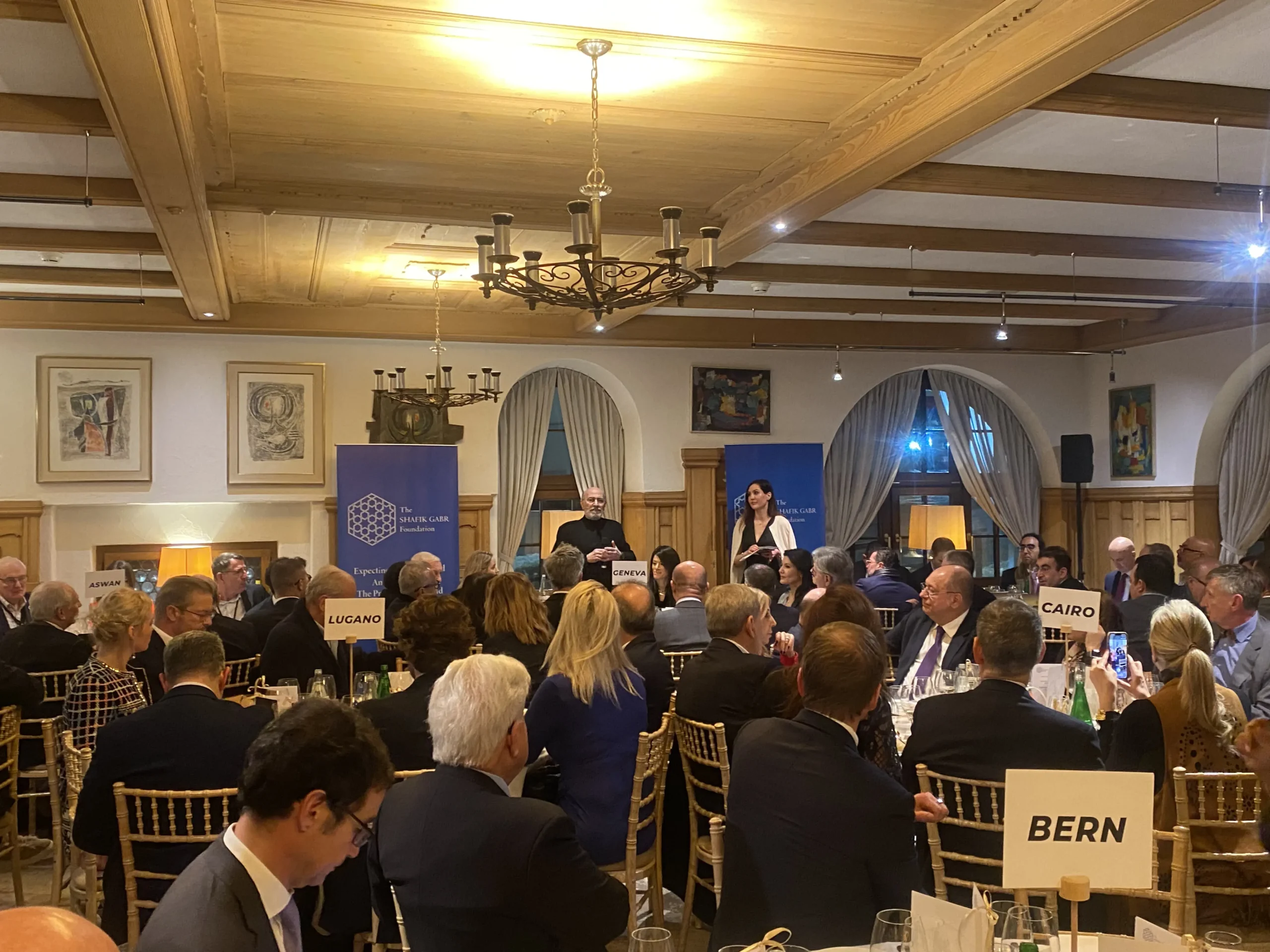
On 19 January 2026, Chairman M. Shafik Gabr, Founder of the Shafik Gabr Foundation, welcomed an exceptional group of international leaders, royal families, former presidents, Members of the U.S. Congress, Ministers, Ambassadors, think tank leaders, business tech leaders, and senior government officials from across 33 countries to the Foundation’s Annual Davos Opening Dinner, Expecting The Unexpected 2026 & Beyond. Held under Chatham House Rule, the discussion emphasised what is most likely to define the year ahead, as uncertainty becomes a feature of the new global order. Across themes of geopolitical realignment, economic rebalancing, accelerating technological capability, and intensified pressure on governance systems, participants converged on the expectation that resilience will increasingly depend on diversification, institutional agility, and adaptive strategic thinking as 2026 unfolds.
Foundation Vision: Building Bridges Between East & West
Chairman Gabr reaffirmed the Foundation’s mission to build bridges between East and West through sustained dialogue and people-to-people exchange. He emphasised the Foundation’s impact: advancing education, healthcare, and social initiatives in Egypt while strengthening dialogue and mutual understanding between the East and the West. He further highlighted how perceptions, stereotypes, and media narratives can deepen divisions and harden misunderstandings across societies.
Healthcare & AI
– One of the most significant potential economic risks identified was the double-edged nature of AI. – AI-driven advances are expected to reshape healthcare at a pace that will exceed system readiness, as delivery models are likely to remain constrained by outdated infrastructure and fragmented databases. – Governments are therefore expected to confront increasingly complex decisions around modernisation, regulation, and investment, as the next phase of technological development shifts from experimentation toward scaled implementation.
Global Economy & Investment
– Investors are expected to remain focused on rebalancing and diversification amid shifting global conditions. – While near-term momentum may persist in certain markets, guests assessed an increased likelihood of volatility and a sustained higher cost of capital as defining conditions ahead.
Geopolitics & Global Governance
– Diplomacy and sustained dialogue are predicted to be essential tools for reducing escalated risks and preventing miscalculation in an increasingly fragmented international environment. – Participants broadly agreed that there is no short-term horizon for resolution across today’s major flashpoints; the year ahead is expected to be shaped by prolonged negotiation, strategic patience, and incremental shifts rather than decisive breakthroughs.
Middle East & Regional Stability
– The region is expected to move through a high-stakes phase in which stability becomes the primary objective, requiring not only political agreements, but governance capacity and sustained delivery. – De-escalation efforts must focus on stopping active wars and reducing the risk of spillover, particularly in relation to Palestine–Israel, and ongoing instability in Libya, Syria, and the humanitarian crisis in Sudan.
Russia–Ukraine & China
– The conflict is expected to remain unresolved, with continued humanitarian cost and limited near-term pathways to a durable settlement. – China is expected to continue strengthening its economic and military capabilities, reinforcing its central role in global markets, supply chains, and strategic competition. – A direct war scenario across the Taiwan strait is not expected in the near future, with stability likely maintained through deterrence, economic interdependence, and careful management of escalation risks.
Conclusion
The coming period is likely to remain defined by instability and strategic uncertainty. Political fragmentation, economic volatility, and persistent geopolitical rivalries, particularly between the United States and its allies, suggest that tensions will endure without meaningful short-term resolution. At the same time, the rapid acceleration of artificial intelligence will begin to reshape economies, governance, and societies. The contrast between rapid innovation and ongoing conflicts highlights a key paradox of our time: while technology is advancing quickly, our collective commitment to peace and shared prosperity is still lacking.